Your child comes home with paint on one sleeve and nothing in their bag. On the tour you were told the centre works in a Reggio-inspired way, and that there is an atelier. You nodded, and then wondered on the drive home whether that means anything in particular, or whether it is craft with a nicer name.
It is a fair question. Here is what an atelier actually is, what your child is doing in one, and how much the space differs from centre to centre — because it does differ, and we would rather say so.
An atelier is a studio, though the closer words are workshop and laboratory. One of our teams has described its ateliers as a creative laboratory: a place for experiences involving the five senses, and a place of research, observation and experiment, deliberately set up so it can be changed as children's questions change.
That last part is the important part. A room that keeps getting rearranged is a room where somebody is following an idea. The materials are not the point. They are how the thinking gets done.
At Morphett Vale, pre-kindy and kindergarten children spent weeks watching a monarch butterfly. They followed it through its chrysalis stage and were there when it emerged, and along the way they talked together about what fruits and vegetables a butterfly might enjoy.
Nobody had planned a project about butterflies. The butterfly turned up, and educators made room for it.
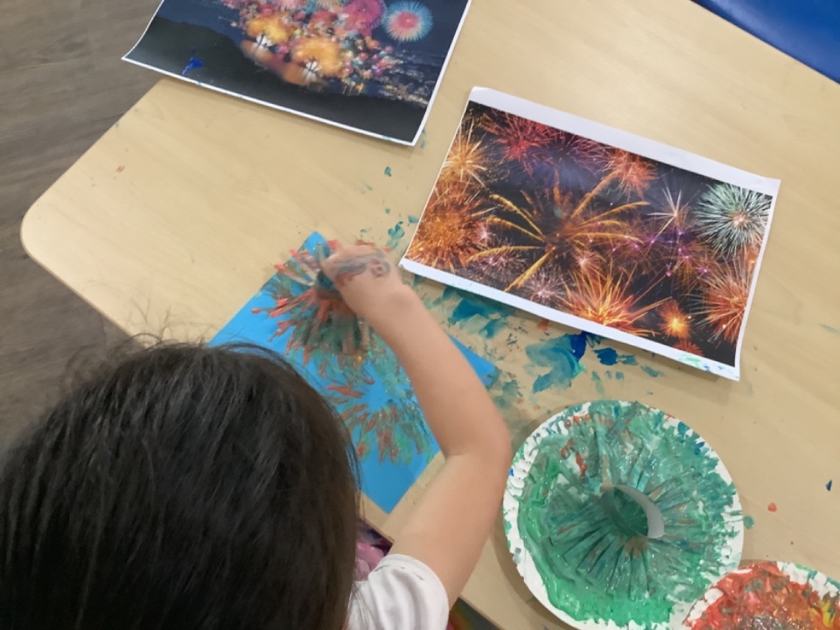
The same thing happens in smaller ways every week. A child notices something on the other side of the window, educators find photographs of it, the children choose the one they like best, and the printed image goes onto a table outdoors as a reference for their own paintings.
At one of our centres, a growing interest in sea creatures became a large collaborative mural on a painted cardboard background, with the kindy children confidently naming the jellyfish, stingrays, starfish, seahorses and seaweed they had learnt about. They also noticed which creatures had been left off, and told our educators to include sharks, sea turtles and sea snakes next time. That correction is the part we like most.
An atelier is not only for the kindergarten room. At one of our centres the kindy children spent a stretch of time building a large cubby house out of recycled boxes in the atelier, and once it was up, the toddlers were brought in to see what their older friends had made.
They crawled through it. They found the windows and the doorways and popped out of them, played peek-a-boo through the gaps, and worked out for themselves how to get from one space into the next. Then their attention moved from the cubby to the boxes it was made of — the pictures printed on them, the logos, the letters. Nobody had planned a lesson about print. It was a room full of packaging and a group of toddlers who had started to notice that the marks on it mean something.
Our educators wrote that visit up as curiosity, spatial awareness and problem-solving, and as the toddlers connecting with ideas the older children had had. What they planned to do next was simply to keep going back.
Not every one of our centres has a room with a name on the door. The way of working shows up differently in each place, and it is worth knowing which you are looking at before you enrol.
So when you visit, ask where the making happens here. It is a short question, and the answer tells you a great deal.
One of our centres has written about why clay is one of the most used materials in the schools of Reggio Emilia, and it remains the clearest short description of open-ended material we have: the hands meet different degrees of heat, texture, dryness, moisture and stickiness, and kneading asks for concentration. The material answers back.
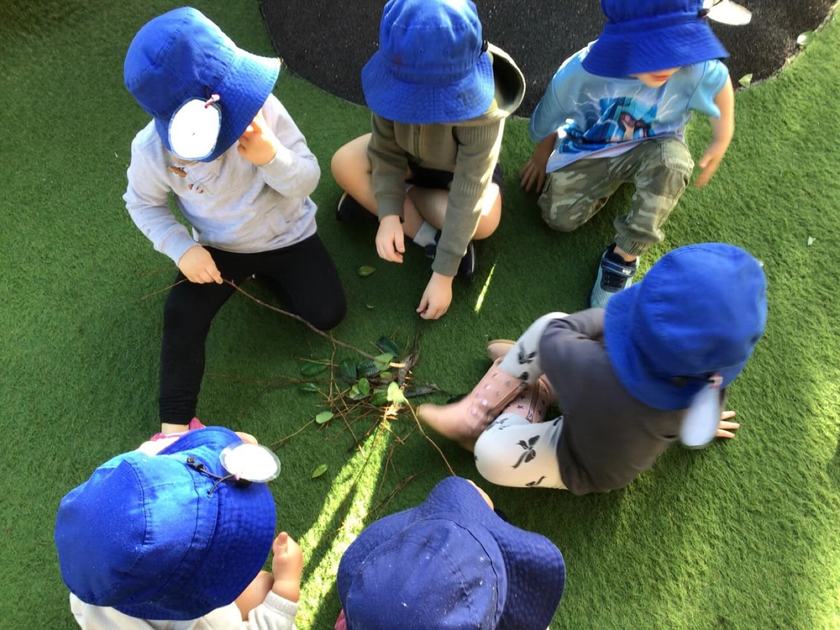
Wet chalk does something similar. Pre-kindy and toddler children at one of our centres dipped chalk into containers of water outdoors and found the colours came up brighter, the chalk glided more smoothly and new textures appeared with every stroke. Cardboard, paper plates, beads, sticks and leaves work on the same principle: the child decides what they are. One of our school-aged children turned cardboard, popsicle sticks and shells into a rocket ship of their own invention.
Our educators at Taranganba work from the idea that art can be made from almost anything: water on stone, a stick decorated with pens, the shadow of that stick traced on a sunny day.
If you assume a two-year-old can only scribble, drawing from observation is worth knowing about. One of our centres has run it with a junior kindergarten group whose average age was two to three: drawing from life, working from the real object in front of them rather than from a photograph or from memory.
What our educators notice in those sessions is how long a young child will stay with one piece of work when the work is genuinely theirs. The EYLF describes this as children becoming confident and involved learners. Standing in the room, it looks like a child who is busy and does not want to be interrupted.
Close looking carries other learning too. Taranganba includes the Traditional Custodians of the land in its program through conversation, art, music and nature exploration, and children there have been observing the colours, shapes and features of local birds, then making and displaying their own artworks. During NAIDOC Week, one of our teams reworked its learning environments with natural loose parts, storytelling invitations, Australian native animals and Dreaming stories, so children could connect with First Nations perspectives through play.
One of our teams shared a photograph of an art table at the end of the day and said that at first glance it might look messy: colourful smudges, splashes and small fingerprints left by nursery children mixing colours and experimenting with brushes. To them it read as the story of the day rather than a mess to apologise for.
What that means for you at pick-up is fairly practical. A stained sleeve usually means your child got in close. A soggy painting means it was finished shortly before you arrived. An empty bag can mean the work is still drying, or it is on the wall, or it was never an object at all — some of the best afternoons leave nothing to carry home.
If "what did you make today" gets you a shrug, try "what were you working on", or "what was the tricky bit".
Some work goes up at the centre. Some comes home. Often the most useful version is a minute at pick-up with the educator who was there, because they can tell you what your child was trying to do, which is not always visible in the finished object. Our educators also write children's learning up in Storypark, our family app, against the outcomes of the EYLF — so a painting you never see still reaches you, with what your child was working on written beside it. Our school-age programs are guided by My Time, Our Place.
All seven of our centres are rated Meeting the National Quality Standard under the National Quality Framework.
A named studio space is not something every centre has, and the materials set out change with what children are currently interested in. Clothing is worth asking about directly rather than assuming: check what's included for the centre you are considering, and ask the team what to send your child in on a painting day, and to show you what a learning story looks like in Storypark with other families' details removed.
A studio is much easier to understand while you are standing in it. Book a tour and ask to see where the making happens at the centre nearest you — find your nearest centre and speak to the team there, and have a look at fees and subsidy before you visit.