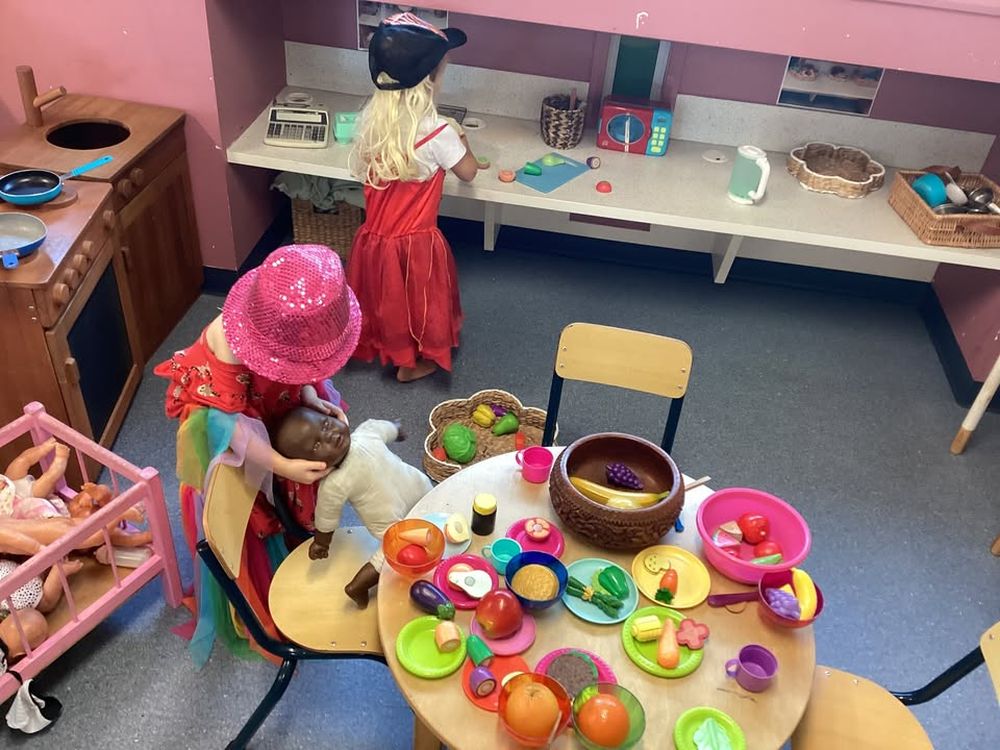
Somewhere on most tours, a parent asks it plainly: so do they just play all day? It is a fair question. From the doorway, a room mid-play looks like children doing a lot of unrelated things, and an art table halfway through the morning looks like a mess rather than a curriculum.
So instead of the theory, here is what play-based learning has looked like in our rooms, drawn from moments our educators recorded.
Our educators call it an invitation to play. They prepare a space and a set of materials, then leave the deciding to the children. Open-ended is the working word: the materials do not tell a child what to make.
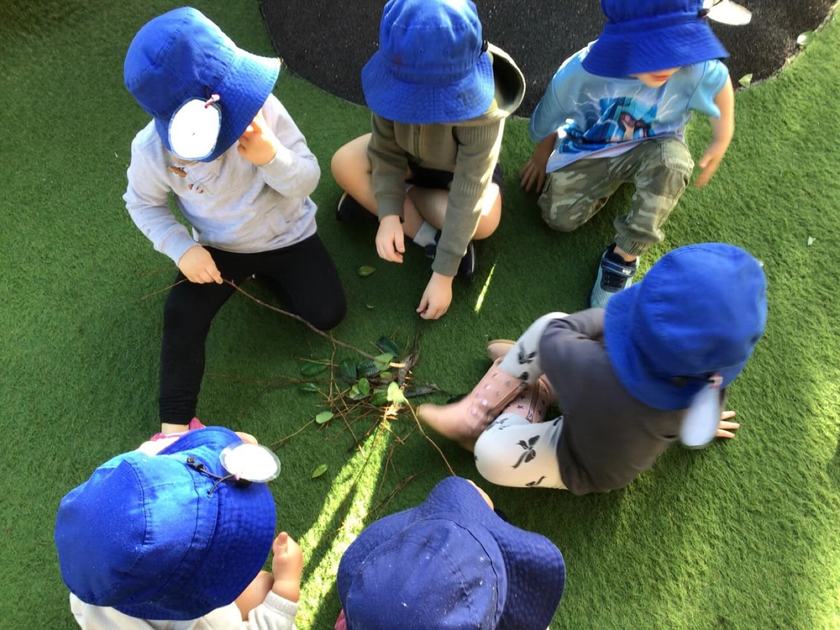
At Taranganba, educators built a small world in the yard from plants, wood, stones, bark and animal figures, then stepped back while children turned it into habitats and stories of their own. At one of our centres, the shelves hold open-ended resources, so a child can fetch what their idea needs without asking first. One of our centres, a Reggio Emilia inspired service, invites the community to donate loose parts.
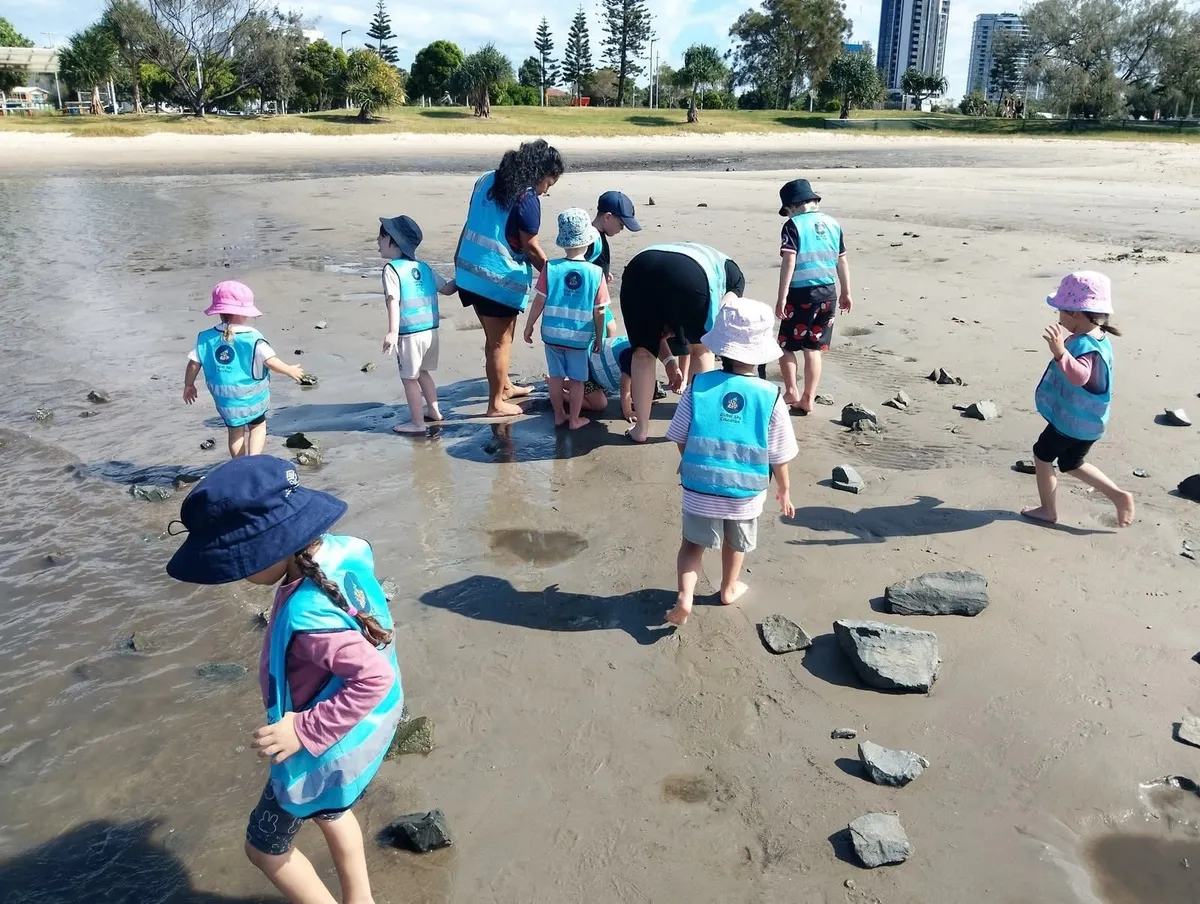
At Taranganba, Pre-Kindy children arranged rocks into a shape they explained was both a road and a love heart. They then collected more rocks and set up a pretend shop, where each one had to be scanned and purchased before joining the creation. Asked what a rock cost, one child confidently named an enormous number.
Inside that half hour: counting, pricing, turn-taking as gatherers and cashier, and sustained attention that is hard to teach directly.
At one of our centres, a school-aged child combined cardboard, popsicle sticks and shells into a rocket ship, a mermaid one by their own account. At Taranganba, a group planned and built a LEGO leisure park with a pool, a diving board and shaded areas, adapting the design as they went. No adult would have set either task.
Play-based does not mean hands off. Our educators watch for the moment when a small piece of help opens the play up.
At one of our centres, a child had a big idea for a playdough farmhouse and needed more room at the table. Instead of clearing the space, an educator encouraged them to ask their friends with kind words. The child asked, the others moved over, and the farmhouse got built. Educators then extended the play into talk about caring for animals.
At Taranganba, when children began noticing bugs in the yard, educators introduced magnifying glasses and bug catchers, turning a passing interest into a week of investigation.
The clearest example we have of the adult's part in this is a stack of drawings from the kindergarten room at one of our centres.
Our educators there took a hard look at what was coming off the drawing table. Several children were still making marks on the page rather than drawing the thing in front of them, which is ordinary enough at that age, but it was where the group had stayed for a while. So the question became what a teacher actually does about it.
What they did not do was hand out stencils or something to trace. Instead one of our educators made a habit of sitting down at the table while children were drawing, and of talking with them about shape — the shapes in a leaf, in a wheel, in a letter — and about looking properly at whatever it was they were trying to get onto the paper. That was the whole intervention. Conversation, at the table, over and over.
Three weeks later the same two children were holding up drawings you could name: one a creature, one a vehicle with wheels. Recognisably drawn, and recognisably theirs.
The EYLF asks that children come to understand that symbols are a powerful means of communication, and that they use mark making and drawing as symbols of communication. Before a child can write, they have to notice shapes and find some way of representing them, and this is our honest position on it: tracing does not teach that. A child who is ready to write their name is a child who has begun to see the shapes inside the letters. Get the noticing right and the tracing turns out to be unnecessary.
What they observe is linked back to the Early Years Learning Framework (EYLF), the national framework for children before school. Our school-age care is guided by My Time, Our Place. Most of it reaches you through Storypark, our family app, where a story about your child is tagged with the outcomes it connects to and ends with what our educators intend to do next.
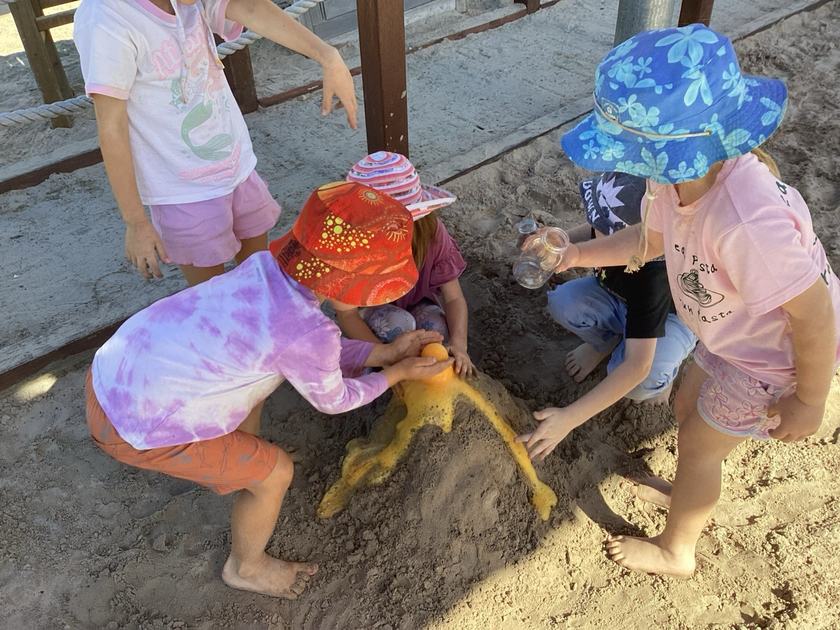
One morning of digging at Taranganba shows how that works. Children shaped sand into what they decided was the Titanic, and the educators' write-up named three EYLF outcomes against it: identity, as children trusted their own ideas; community, as they worked side by side; and wellbeing, through the digging and patting itself.
The framework carries the developmental language. Our educators record what they saw.
Parents of under-twos often assume play-based learning begins at kindy age. In our nurseries it looks like this:
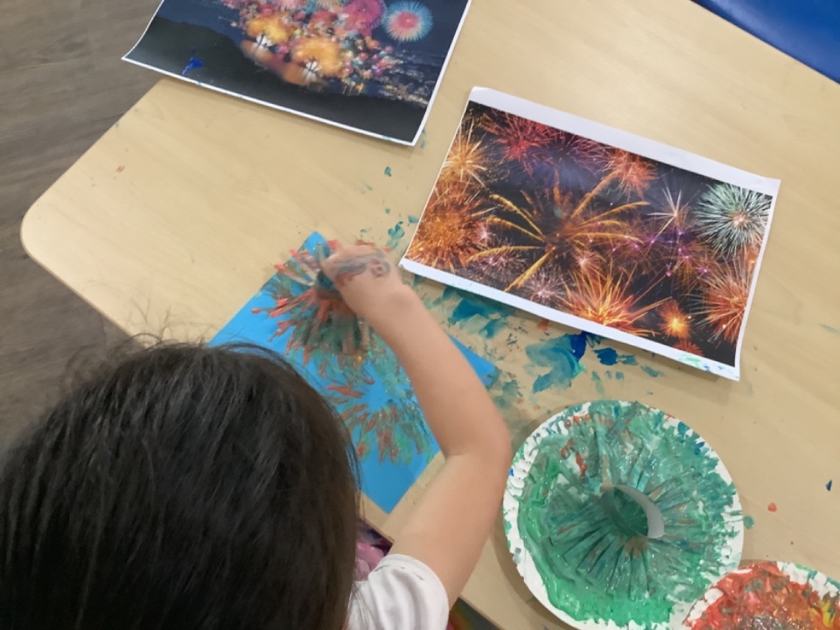
An art table at the end of a nursery session at one of our centres is covered in smudges, splashes and small fingerprints. Our educators do not clear it away too quickly. Every mark is somewhere a child tried something.
Play is also where children practise managing themselves. Pre-Kindy children at Taranganba have been painting their feelings, prompted by questions our educators ask: what colour is your feeling, is it spiky or soft, where do you feel it in your body. Sensory bottles sit in the room as something to reach for when feelings get big.
Pre-Kindy children at one of our centres collected natural treasures on an excursion, then combined them back at the centre with cardboard, paper plates, leaves, sticks and beads. Kindy children there travelled on the centre bus to a First Nations storytelling session, which continued with dancing and colouring.
During NAIDOC Week, a Global Sky Education centre changed its learning spaces: natural loose parts, storytelling invitations, native animals, Dreaming stories, and a sand tray with wooden tools for children to make their own markings. At Taranganba, learning about the Traditional Custodians of the land is intentionally part of the program, with a current focus on local birds.
Play looks different from one centre to the next, and from one day to the next. Not every centre runs Vacation Care or the same excursions, and room names vary. Some of our centres provide meals; at others families pack food, so check what's included where you are. To see how your child's learning is recorded, ask your centre to show you a learning story in Storypark with other families' details removed.
The quickest way to see this is to stand in a room while it is happening. Book a tour at your closest centre, and ask our educators what is set up today, and who decided. All seven of our centres are rated Meeting the National Quality Standard. You can find your nearest centre, or look over fees and subsidy first.